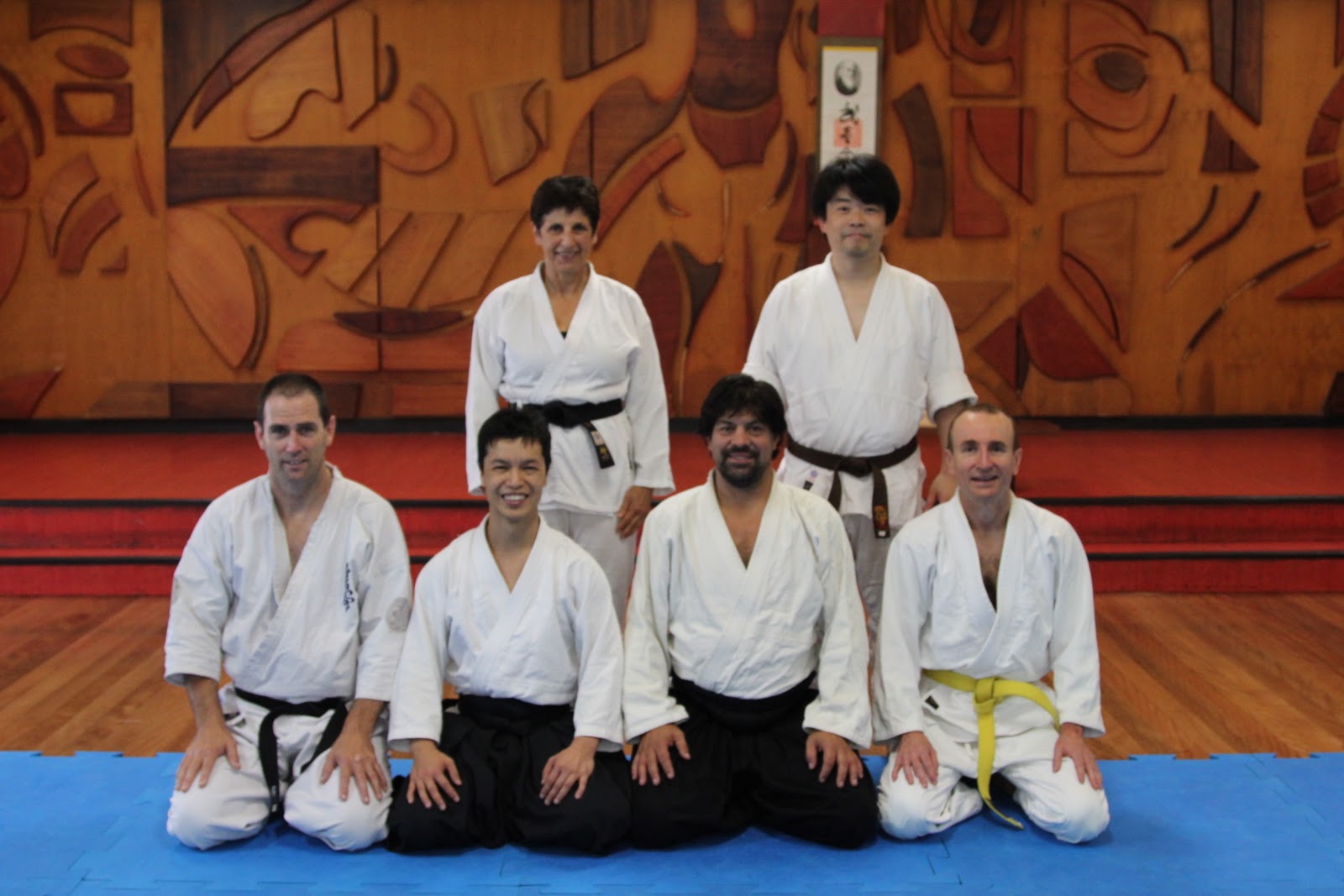
Around this time last year Lilyfield Aikido instructor, Bruce Choy, participated in the 48th All-Japan Aikido Demonstration in Tokyo's Nippon Budokan stadium. Organised by the Aikikai Foundation and hosted by Doshu (head of Aikido and grandson of O'Sensei), it is the largest regular gathering of aikidoka covering two full days of demonstrations
Lilyfield dojo provides options for their students to visit and train in Japan.
Wednesday, June 1, 2011
Tuesday, May 10, 2011
Photos by Warwick Kent
Last week we had professional photographer Warwick Kent of Platinum Graphics come and visit the dojo. Unable to train due to injury (Warwick had passed his 3rd dan black belt examination in Japan supervised by Hitohiro Saito sensei) he took some wonderful action photos of the night. Many thanks!
Monday, April 18, 2011
Demonstration of the first grading test
Lilyfield Aikido head instructor, Ian Thomson, with the assistance of instructor Abe Lau, demonstrates the the 5th kyu grading that our beginning white-belt students have to do as their first test.
Sunday, April 17, 2011
Blokes in Skirts
If you’ve ever watched an aikido class you’ve most likely seen some of the senior martial artists wearing something that looks like a black or dark blue skirt.
No, this is not some sort of weird cross dressing habit. (This is not to say that senior aikidoka aren’t into cross dressing... they just prefer to wear full sequined ball gowns when doing so.)
The “skirt” is in fact called a “hakama”. Hakamas actually have a join in the middle forming two legs so they’re less a skirt and more a pair of pantaloons. I know... it's still not sounding that impressive yet...
How about this then: hakama were originated by samurai. In feudal Japan, many samurai would often wear silk kimono. However when conducting duties which involve riding a horse, the delicate silk would be either be eroded or soiled by the riding action in the saddle or by riding through tall grass and shrubbery. Hakama were constructed of hardier fabric - cotton or hemp - and worn over their finer clothes to protect them. Even as samurai made the transition from horse mounted to foot soldiers, they continued to wear hakama to identify themselves. (So you see, senior akidoka aren’t weirdos who wear skirts - they’re weirdos who wear chaps.)
In our style of aikido, you earn the right to wear the hakama when you successfully grade as a first level black belt. Even after a few years I still get a buzz from wearing it and feel honoured to be able to wear it.
No, this is not some sort of weird cross dressing habit. (This is not to say that senior aikidoka aren’t into cross dressing... they just prefer to wear full sequined ball gowns when doing so.)
The “skirt” is in fact called a “hakama”. Hakamas actually have a join in the middle forming two legs so they’re less a skirt and more a pair of pantaloons. I know... it's still not sounding that impressive yet...
How about this then: hakama were originated by samurai. In feudal Japan, many samurai would often wear silk kimono. However when conducting duties which involve riding a horse, the delicate silk would be either be eroded or soiled by the riding action in the saddle or by riding through tall grass and shrubbery. Hakama were constructed of hardier fabric - cotton or hemp - and worn over their finer clothes to protect them. Even as samurai made the transition from horse mounted to foot soldiers, they continued to wear hakama to identify themselves. (So you see, senior akidoka aren’t weirdos who wear skirts - they’re weirdos who wear chaps.)
In our style of aikido, you earn the right to wear the hakama when you successfully grade as a first level black belt. Even after a few years I still get a buzz from wearing it and feel honoured to be able to wear it.
Sunday, March 27, 2011
Visit by Daniel Falero sensei
| Front row (L-R) Lilyfield dojo instructors Mick and Bruce with guest sensei Daniel Falero, in a photo with the other visiting students from Eastern Suburbs dojo |
Saturday, March 12, 2011
Japan Earthquake and Tsunami
Thursday, March 10, 2011
If Benji also did Aikido?
![]() |
| Boxing classes at a West-Tigers training session |
Without going into the circumstances of the incident, it highlighted the limitation of a pure striking art in the modern world of litigation. Striking (atemi) is an important part of Aikido. Indeed O-Sensei once stated that striking was “90% of Aikido”. However a martial art like Aikido provides versatility beyond just hitting someone really hard. From unbalancing, throws, trips, joint-locks, chokes, pressure points, strategies for handling multiple opponents all the way up to escalation where serious bodily harm could be done, one of Aikido’s strength’s is providing options which (with skill) can be adapted to the situation. How things 'may' have turned out differently with an Aikido response.
Of course with such a smorgasbord of skills to learn, it means Aikido provides a life-time of discovery ...
PS. Go Tigers for NRL season 2011!
Update: Benji was acquitted from the assault charge
Friday, March 4, 2011
Reflections on Canberra Dojo Gradings
A new dojo is a place of fear, anticipation, dreams and smiles of delight. Canberra dojo started with an explosion of visitors and a great opening seminar in 2008.
Then the visitors went home and Ann Reekie Sensei was on her own to pass on Aikido. When I attended grading’s there last week I realised just how Aikido evolves in the traditional way. The graciously gentle art of giving together with given time.
Two years ago the students were all first timers on the mat. As you can imagine there was a (how can I say) a mess of concepts as to what was supposed to be going on, as to what one saw when the demonstrations were ‘YouTube-d’ to your enlightenment.
There was however, this time a structure of learned Aikido that was demonstrated to the point where grades were awarded according to time honoured tradition. In fact there was a small tradition that has started there, which I have only seen at Ann Sensei’s dojo. Of course you will only learn this tradition by joining her family.
I can’t wait for the next grading to discover the next stage in an evolving dojo and the gentle art of Aikido.
Mirror

When someone grabs you and you resist then a tussle ensues. Before you are grabbed one needs to release themselves of bringing their mind to the grab point. It’s like a Harry Potter mirror; give a person something to read that provokes them and they only see their own existence in it.
Release yourself of the moment that is about to occur. Same as how I write blogs, full of good intent, however “obscure and illusive”.
Wednesday, March 2, 2011
Aiki-Ken Demonstrations on YouTube
The bokken (lit. 'wooden sword') is a tool used to augment our Aikido training. Several YouTube videos have been recently uploaded to assist our beginners with the curriculum of Aiki-Ken (i.e. the Aikido usage of the bokken). The following demonstrations are by Adam Cole-Clark, one of instructors at our Sydney City branch dojo.
1. Ken suburi : seven basic solo exercises
2. Happo-giri : "eight-directional cut" solo exercise
Aiki-Ken is an important component of Iwama-style Aikido.
1. Ken suburi : seven basic solo exercises
2. Happo-giri : "eight-directional cut" solo exercise
Aiki-Ken is an important component of Iwama-style Aikido.
Monday, February 28, 2011
Canberra dojo gradings - February 2011
| Ian Thomson sensei presiding over grading night at Canberra dojo |
Lilyfield dojo's head instructor, Ian Thomson sensei, conducted gradings at our sister dojo in Canberra last week. Congratulations as everyone passed their tests that evening. Congratulations also to Ann Reekie sensei of Canberra dojo for preparing her students for their grading exams.
Transmission of Morihiro Saito sensei's Aikido
As a fly-in instructor at a dojo where the students are of a generation after 2002 and the passing of Saito Sensei, it was a great surprise after showing some old Saito Sensei video that the students were amused to at last discover why my Aikido looked so different and where my style came from.
After all this time I thought we were doing the same Aikido. Well in my mind at least we have been.
Sunday, January 16, 2011
Ibaraki-Shibu Dojo in Iwama, Japan
Iwama is a small town in Japan between Tokyo and Mito. It is where O'Sensei completed his development of Aikido. Still training at the original Ibaraki-Shibu dojo in Iwama for nearing 50 years is Toshihiro Isoyama sensei. He started training under O'Sensei and received his nidan (2nd dan black-belt) from the founder of Aikido, and then continued his Aikido development under the tutelage of Morihiro Saito shihan.
Above is a short video of Lilyfield Dojo instructor Bruce Choy having some fun and being thrown around by Toshihiro Isoyama sensei after an Aikido class in the old Iwama dojo.
Note that training in Japan is an option that can be arranged for those students of Lilyfield Dojo who may be interested in experiencing the birth-place of Aikido.
Training has started for 2011
| Training at Lilyfield Aikido Dojo |
Training will return to Lilyfield Community Centre on Wednesday 9 February.
Annual registration forms and fees are now due.
Saturday, October 9, 2010
Lilyfield Community Centre
Iwama-style Aikido under the tutelage of Ian Thomson sensei started in May 2000 with his new dojo located in the grounds of the Royal Prince Alfred Hospital, Camperdown. Over the years the dojo has moved location and since April 2009, has found a new home at Lilyfield Community Centre. The above video was taken from the first night of training with the dojo's instructor team.
Lilyfield Community Centre is located at 19 Cecily St (cnr O'Neil St), Lilyfield NSW 2040
Head Instructor - Ian Thomson sensei
Ian sensei has been training in Aikido since 1987 and has been running the Association dojo within the Inner West of Sydney since 2000. He was awarded his 4th dan (yondan) level black-belt accreditation from the Aikikai Foundation in 2006.
His dojo philosophy is up until first dan black-belt (shodan) Ian sensei considers the basics (kihon) are of utmost importance, so that everyone can make Aikido their own. After black-belt, Ian sensei encourages one's own personal development through Aikido.
Welcome to Lilyfield dojo's new blog site
Aikido is a Japanese martial art renowned for its dynamic throwing techniques and arresting joint locks. Literally translated to “path of harmonious energy”, Aikido was founded by Morihei Ueshiba (1883-1969) who developed it from the state of a martial, battle-ready collection of techniques to a process for strengthening both the body and spirit.
Based upon biomechanical principles of structure and balance, it allows people to defend themselves against larger and stronger attackers, without requiring great strength or speed. It also teaches us to more deeply understand and respect one another. The friendly, non-competitive environment in which traditional Aikido is taught makes it appealing to men, women and youths.
Subscribe to:
Posts (Atom)